
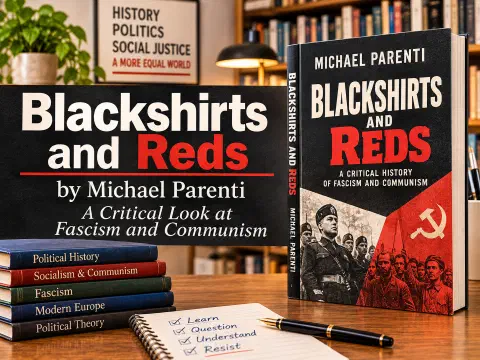
Blackshirts and Reds: Rational Fascism and the Overthrow of Communism (1997) by Michael Parenti argues that fascism serves the interests of capital in times of crisis, and that Western accounts of communist states have been one-sided. It is a deliberately provocative and controversial book, and it should be read with care.
What Is Blackshirts and Reds About?
Parenti, a political scientist and writer, makes two main arguments. First, he says fascism was not an irrational explosion but a response that protected the property and power of elites against labor movements. Second, he argues that mainstream accounts overstate the failures of communist states and ignore their social gains, and that the end of those states led to hardship in many countries.
Key Ideas
- Fascism and capital. He argues that business and political elites often backed fascist movements to defeat the left.
- “Rational” fascism. The title points to his claim that fascism served concrete class interests, not just irrational hatred.
- A revisionist view of communist states. He argues that they achieved gains in areas like literacy, health care, and employment, and that critics ignore context such as outside hostility.
- The role of ideology and media. He claims that anticommunism shapes how this history is told.
Criticisms and Limits
This is the most contested part of the book. Many historians say Parenti downplays or dismisses well-documented repression, famine, and killings under Stalin and other communist governments, and that his sources and conclusions are selective. Scholars of fascism also describe its causes as more complex than serving capital alone. Reading Parenti alongside mainstream historians of the Soviet Union and of fascism is essential.
My Perspective
I’m a Marxist and a humanist, and I think the part of the book connecting fascism with the defense of economic power is worth taking seriously. But humanism also means taking the victims of any regime seriously, and I do not accept minimizing repression because it was carried out in the name of a cause I might otherwise sympathize with. For me, critical thinking means applying the same standard to every side, including my own. I included this book because I want to read perspectives I may not fully agree with, and I think readers should do the same and compare them with other historians.
Questions Worth Discussing
- How should we judge a political project by its ideals versus its results?
- Why do elites sometimes support authoritarian movements?
- How can we read a polemical book fairly?
Frequently Asked Questions
What is Blackshirts and Reds about?
It is a book by Michael Parenti arguing that fascism served elite economic interests and that mainstream accounts of communist states are biased.
When was Blackshirts and Reds published?
In 1997.
Why is the book controversial?
Critics say it minimizes well-documented repression in communist states and oversimplifies the causes of fascism.
Conclusion
Blackshirts and Reds is a provocative book that challenges common assumptions, and that deserves to be challenged in return. Read it critically, with other sources beside it.
What do you think? How should we weigh the achievements and the abuses of political systems? I’d like to hear your thoughts, so feel free to get in touch.
Related Reading
Want to keep reading? These related posts pair well with this one: