
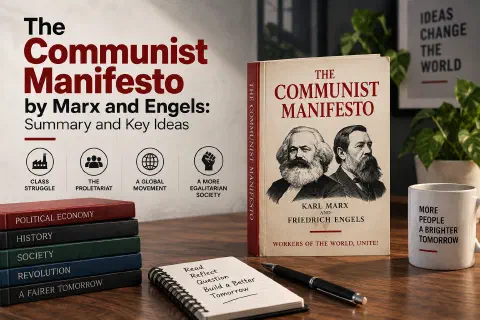
The Communist Manifesto is a short political pamphlet published in 1848 by Karl Marx and Friedrich Engels. It argues that the history of society is a history of class struggle, and that capitalism will be replaced by a society without classes. It is one of the most influential and most misunderstood texts ever written, and it is short enough to read in an afternoon.
I read it because I like to understand ideas at the source instead of through other people’s summaries. This post covers what the Manifesto actually says, its key ideas, and why people still argue about it more than 175 years later.
What Is The Communist Manifesto?
The Manifesto was written by two German thinkers, Karl Marx and Friedrich Engels, for a group called the Communist League and first published in London in 1848. It is a pamphlet of a few dozen pages, not a long book. Its original German title translates as the Manifesto of the Communist Party.
It is a political document as much as a work of analysis. It explains how the authors see history and the economy, and it tells the reader what they think should happen next. It opens with one of the most famous lines in political writing: “A spectre is haunting Europe, the spectre of communism.”
How Is It Organized?
The text has a short preface and four parts:
- Bourgeois and Proletarians. The core of the argument: a description of history, capitalism, and class conflict.
- Proletarians and Communists. What the communists want, and answers to common objections, including a list of proposed measures.
- Socialist and Communist Literature. A critique of other socialist movements of the time.
- Position of the Communists in Relation to the Various Opposition Parties. How communists should relate to other political groups. It ends with the call, “Workers of all countries, unite!”
The Key Ideas
History as Class Struggle
The Manifesto’s best-known claim is that “the history of all hitherto existing society is the history of class struggles.” Free people and slaves, lords and serfs, guild masters and workers: in each era, the authors say, one group controls the means of production and another group works for them.
Bourgeoisie and Proletariat
In capitalism, the two main classes are the bourgeoisie, the owners of factories, land, and capital, and the proletariat, the workers who have nothing to sell but their labor. The authors argue that the interests of these two classes are in conflict, because owners profit by paying workers less than the value they create.
Capitalism’s Revolutionary Role
The Manifesto is surprisingly admiring of what capitalism achieved. It describes how the bourgeoisie created enormous productive power, tore down old feudal ties, and spread across the globe. It describes a world market that reshapes every country, which reads very much like what we now call globalization.
Alienation and Dependence
Workers, the authors argue, become an appendage of the machine. Their work loses its meaning, and their wages depend on the market. That idea, that people can lose control over the products of their own work, is one reason the Manifesto still feels relevant in the age of platforms and algorithms.
The Proposed Measures
At the end of Part 2, the authors list measures they say would apply in the most advanced countries. They include a progressive income tax, public ownership of certain industries and credit, and free education for all children in public schools. Some of these ideas, like progressive taxation and public education, are now ordinary features of many countries.
The Goal: A Classless Society
The Manifesto’s long-term goal is a society without class divisions, where, in its words, “the free development of each is the condition for the free development of all.”
Why It Still Matters Today
Whether you agree with it or not, the Manifesto shaped the modern world. It influenced labor movements, political parties, revolutions, and a large body of economics and philosophy. Its questions are still live: who owns the economy’s most important assets, how wealth is shared, and what happens when technology changes the nature of work.
You can see echoes of those questions in modern debates about big tech and artificial intelligence. I wrote about one example in my review of Technofeudalism by Yanis Varoufakis, which asks whether a few platform owners now hold a kind of power over everyone else. And the Manifesto’s call for public education connects with another book I reviewed, Deschooling Society by Ivan Illich, which questions what schools are really for.
My Perspective
I’m a humanist, so I read the Manifesto with sympathy, but not as scripture. I like questioning established ideas, and that includes ideas I agree with. A few things stand out to me:
- It is a call to think critically about power. The most useful thing the Manifesto does is ask who owns what, and who benefits. That question still applies, whatever answer you reach.
- It is a product of its time. It was written in 1848 by two young men during a period of revolutions in Europe. Some of its predictions did not come true in the way they expected, and reading it as a prophecy misses the point.
- Knowledge should be accessible to everyone. I believe in the free exchange of knowledge, which is why I support open-source software. Reading the original text, instead of relying on slogans, is part of that.
- History needs honest reading. Many regimes of the twentieth century claimed to act in Marx’s name, and some were authoritarian and caused great suffering. I think it is important to look at that history honestly and critically, and to ask what the text actually says and what was done in its name.
Common Criticisms
The Manifesto has been criticized from many directions, and a fair reading includes them:
- Predictions: Marx and Engels expected revolutions in the most industrialized countries. Instead, many of those countries developed unions, labor laws, welfare states, and rising living standards.
- Human nature and incentives: Critics argue that a classless society ignores how people respond to incentives, and that markets are better at coordinating information.
- Practice: Critics point to the concentration of power and the lack of freedoms in states that called themselves communist.
- Supporters’ replies: Defenders reply that those regimes departed from the text, that reforms like labor protections were won by the very movements the Manifesto inspired, and that the analysis of inequality remains useful.
I think you learn more by reading both the text and its critics.
Questions Worth Discussing
- How much of the Manifesto’s analysis of capitalism still describes today’s economy?
- Is class still the most useful way to understand inequality, or are there better frameworks?
- How should we read ideas whose history includes both inspiration and harm?
Frequently Asked Questions
What is The Communist Manifesto about?
It is a political pamphlet by Karl Marx and Friedrich Engels that describes history as a series of class struggles, criticizes capitalism, and argues that workers will eventually replace it with a classless society.
Who wrote The Communist Manifesto, and when?
Karl Marx and Friedrich Engels wrote it, and it was first published in London in 1848.
Is The Communist Manifesto hard to read?
It is short, but it uses nineteenth-century language and references. Reading it with a good introduction or study guide helps a lot.
Is communism the same as socialism?
Not exactly. Both terms have many meanings, and people use them differently. In Marx’s writing, socialism and communism are related stages and goals. Their meaning also changed over time, so it helps to check how each author or country uses the term.
Is The Communist Manifesto still relevant?
Many readers think so, because it raises lasting questions about ownership, inequality, and power, even if they disagree with its answers.
Conclusion
The Communist Manifesto is a short, forceful text that is easy to quote and harder to read carefully. Whether you see it as a roadmap, a warning, or a historical document, reading it yourself is the best way to judge what it actually says.
What do you think? Does the Manifesto’s analysis of class and power still help us understand the world? I’d like to hear your thoughts, so feel free to get in touch.
More book reviews: Understanding Socialism by Richard D. Wolff: Book Review, Rules to Win By by Jane McAlevey: Book Review and Takeaways, Blackshirts and Reds by Michael Parenti: Book Review.