
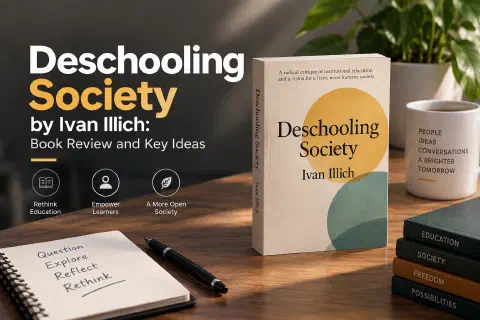
Deschooling Society is a 1971 book by Ivan Illich that argues schools often teach people to depend on institutions, grades, and diplomas instead of teaching them how to learn. I just finished reading it, and it left me thinking about the purpose of education and how we approach learning.
The book is more than fifty years old, but its questions feel current. As someone who works in educational technology and data, I read it with one eye on the classroom and the other on the tools that are changing how people learn.
What Is Deschooling Society About?
Deschooling Society was written by Ivan Illich, an Austrian-born philosopher and social critic. His central claim is uncomfortable: modern schooling often confuses being taught with learning, moving up a grade with getting an education, and holding a diploma with having a skill.
Illich also describes what is often called the hidden curriculum. Beyond math and reading, students learn that knowledge comes in packages, that someone with authority decides what is worth knowing, and that being educated means having the right paperwork. In his view, schools can teach people to need schools.
The Big Ideas
Learning Doesn’t Have to Happen in a Classroom
The idea that stayed with me most is that learning should not be limited to classrooms, grades, or institutional systems. People learn through experience, curiosity, exploration, and conversations with other people. Think of how you learned to cook, to fix something, or to use the tools you rely on at work. Most of it probably didn’t happen in a lecture hall.
Learning Webs
Illich didn’t only criticize. He proposed an alternative he called learning webs: networks that let people find what they want to learn, without a mandatory curriculum. He described four kinds:
- Access to learning resources, such as libraries, labs, and tools anyone can use.
- Skill exchanges, where people who know how to do something can be found by people who want to learn it.
- Peer matching, so people can find others who want to explore the same topic.
- Access to educators, a way to find teachers, mentors, and experts when you want guidance.
He wrote this before the internet existed, which is why readers often compare learning webs to today’s online communities, open courses, tutorials, and video platforms.
Why It Still Matters Today
Reading the book now, the parts that stand out are the ones about technology and AI. Free tutorials, open-source projects, online communities, and AI assistants make it easier than ever to learn something on your own. If you want to see how fast that has changed, look at the number of free resources for learning web design or the beginner-friendly guides to topics like machine learning that would have needed a university course not long ago.
But access isn’t the same as learning. Having an endless supply of information doesn’t tell you what to learn, how to judge what’s reliable, or how to stay motivated. And technology in schools brings its own questions, including how student data is collected and protected.
I think the biggest challenge for education is not simply adopting new technology. It is rethinking what learning should look like.
My Perspective
I came to this book as an atheist, a humanist, and a Marxist, and with a lot of curiosity about how people learn. It was interesting to find that Illich was a Catholic priest, yet his critique is aimed at institutions in general, and I share much of that skepticism. I like to question established ideas, and few ideas are more established than “school equals education.”
My own view is shaped by a few beliefs:
- Knowledge should be accessible to everyone. I support the free exchange of knowledge, and that is a big reason I care about open-source software and open resources. Learning shouldn’t depend on who can afford the right school or the right diploma.
- Critical thinking is essential to human progress. The best education teaches people to question, not just to memorize what will be on the test.
- Curiosity is the engine. I enjoy studying history, exploring philosophy, and understanding technology, and almost none of that learning happened because someone graded me on it.
From a Marxist perspective, I also read the book as a question about class. Credentials and access to elite schools often reproduce inequality, so I’m sympathetic to Illich’s suspicion of the system. At the same time, I think public education matters because it is one of the few places where everyone can, in theory, get access to knowledge. The goal, in my view, is not to abandon it but to make learning more open, more critical, and less about ranking people.
Where I Disagree (Or at Least Hesitate)
I don’t think Illich is entirely right. Schools do more than certify people: they provide structure, a safe place for children, access to teachers, and a shared base of knowledge. Not everyone has the time, support, or confidence to direct their own learning, and a world with no credentials could make existing inequalities worse.
Credentials also still matter in many careers. Something like an IT certification is, in a sense, an institution’s stamp on a skill, and employers often rely on it. That doesn’t contradict Illich’s point, but it shows how deeply the system is built into how we hire and promote.
What I take from the book is not “abolish schools.” It is that we should ask what schools are for, and whether we are measuring learning or only measuring compliance.
Questions Worth Discussing
The book raises questions I keep coming back to:
- Are schools preparing students to learn, or simply preparing them to pass exams?
- Can technology help make learning more independent?
- What should the role of teachers and schools look like in the future?
Frequently Asked Questions
What is Deschooling Society about?
It is a critique of institutional schooling. Ivan Illich argues that schools tie learning to grades, curricula, and diplomas, and he proposes replacing them with open networks that let people learn from resources and from each other.
When was Deschooling Society published?
In 1971.
What does “deschooling” mean?
In Illich’s sense, it means separating learning from the institution of school, so that learning is not limited to classrooms, grades, and credentials.
Is Deschooling Society still relevant?
Many readers think so, especially now that online courses, communities, and AI tools let people learn outside traditional schools. The book is a useful starting point for asking what schools should do in that world.
Conclusion
Sometimes the best way to move education forward is to question assumptions we’ve held for decades. Deschooling Society is a thought-provoking book whether you agree with it or not.
What do you think? Is our traditional model of education ready for a fundamental transformation? I’d like to hear your thoughts, so feel free to get in touch.
Another book that made me think about technology and power is Technofeudalism by Yanis Varoufakis.
I also reviewed The Communist Manifesto by Marx and Engels, which calls for free public education.
More book reviews: Beyond Good and Evil by Nietzsche: Book Review and Key Ideas, The Skeptics’ Guide to the Universe: Book Review and Takeaways, God Is Not Great by Christopher Hitchens: Book Review.