
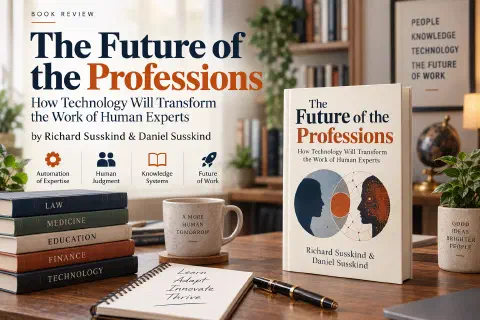
The Future of the Professions (2015) by Richard Susskind and Daniel Susskind argues that technology will gradually dismantle the traditional professions, such as law, medicine, teaching, and accounting, by making expert knowledge available in new, cheaper, and more widely shared ways. It is a book about work, expertise, and who gets access to knowledge.
What Is The Future of the Professions About?
The authors, a father and son who work on law, technology, and economics, start from what they call the “grand bargain”: society gives professionals special status and exclusive authority in exchange for their expertise and trust. The book asks whether that bargain still makes sense when knowledge can be captured in software and shared online.
Key Ideas
- Professionals are gatekeepers. Expertise used to be scarce, so people paid professionals to access it. Online tools make a lot of practical expertise reusable.
- Work can be broken into tasks. Many routine tasks can be done by systems, by less specialized workers, or by the people who need the service.
- Two possible futures. One is a more efficient version of today’s professions. The other is a transformation where machines and non-professional providers take over much of the work. The authors expect the second to grow.
- Change comes task by task. Professions rarely vanish overnight. They change piece by piece.
Criticisms and Limits
Critics say the book can underestimate judgment, empathy, and trust, which matter a lot in fields like medicine and counseling. Professional bodies and regulation may also slow the change. And since the book came out, AI tools have advanced quickly, so some of its predictions look closer, while others are still uncertain.
My Perspective
This book connects with beliefs I hold: knowledge should be accessible to everyone, and expertise locked behind high prices and credentials is a barrier. If technology makes legal, medical, and educational knowledge cheaper and easier to reach, that is good for people. As a humanist, I want technology to expand what people can do, not just to cut costs. And as a Marxist, I ask who owns the systems that hold the expertise: if a few companies own them, we may only trade one gatekeeper for another, as I discuss in my review of Technofeudalism.
Questions Worth Discussing
- Which parts of your job could be broken into tasks that a machine can do?
- Should expert knowledge be treated as a public good?
- Who should own and control the systems that hold professional knowledge?
Frequently Asked Questions
What is The Future of the Professions about?
It is a book by Richard and Daniel Susskind arguing that technology will change or replace much of the work of traditional professions such as law, medicine, and teaching.
When was The Future of the Professions published?
In 2015.
Will AI replace professionals?
The authors argue that many tasks will be automated and that professions will change a great deal, though how fast and how far is still debated.
Conclusion
The Future of the Professions is a useful book for anyone who wonders how their own work might change. Whether or not you agree with every prediction, it asks the right question: what do we want expertise to look like in a world of intelligent machines?
What do you think? Will technology make expert knowledge available to everyone, or will it just move the gatekeepers? I’d like to hear your thoughts, so feel free to get in touch.
Related Reading
Want to keep reading? These related posts pair well with this one: