
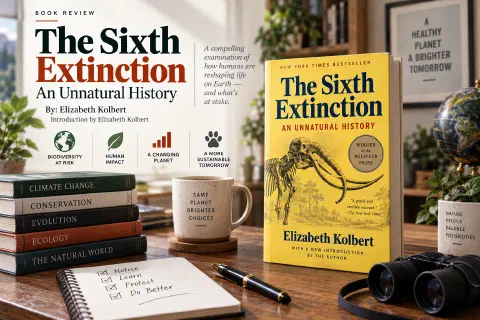
The Sixth Extinction: An Unnatural History (2014) by Elizabeth Kolbert argues that Earth is in the middle of a mass extinction caused by human activity, the sixth in the planet’s history. It is a readable, well-reported book that mixes science, history, and travel.
What Is The Sixth Extinction About?
Kolbert, a journalist for The New Yorker, travels to places where scientists are studying species at risk, from rainforests to coral reefs. She explains how earlier mass extinctions happened, how scientists discovered the idea of extinction itself, and how humans now change the planet through climate change, habitat loss, and the movement of species around the world.
Key Ideas
- Mass extinctions are rare and dramatic. Earth has had five major ones, usually tied to huge environmental changes.
- Humans are now the cause. Habitat destruction, overhunting, invasive species, ocean acidification, and warming all add up.
- Extinction is a scientific discovery. The idea that species can disappear forever was once new and controversial.
- The effects are interconnected. Losing one species can disrupt whole ecosystems.
Criticisms and Limits
The book is a work of journalism, so it summarizes complex science for general readers. Scientists continue to debate how to measure current extinction rates and how they compare to past events. Some readers find the tone bleak, though Kolbert avoids easy predictions and focuses on evidence.
My Perspective
Reading this book was a reminder of why I value curiosity and science. As a humanist, I think humans have a responsibility to the world we share, and that means looking honestly at the evidence. As a Marxist, I also notice that environmental damage is tied to how we organize the economy, since production for profit often ignores costs that fall on everyone. I think critical thinking and open access to scientific knowledge are essential if we want to respond well.
Questions Worth Discussing
- What is our responsibility to species we may never see?
- How should economies account for environmental damage?
- What can individuals do compared with governments and companies?
Frequently Asked Questions
What is The Sixth Extinction about?
It is a book by Elizabeth Kolbert about how human activity is driving a mass extinction of species, drawing on field reporting and scientific research.
When was The Sixth Extinction published?
In 2014, and it won the Pulitzer Prize for General Nonfiction the following year.
Is it a hopeful book?
It is sobering, but it is built on evidence and gives readers a clear picture of what is at stake.
Conclusion
The Sixth Extinction is a clear, human, and serious look at what we are doing to the living world. It is a good example of science writing that informs without exaggerating.
What do you think? How should societies respond to the loss of biodiversity? I’d like to hear your thoughts, so feel free to get in touch.
Related Reading
Want to keep reading? These related posts pair well with this one: