
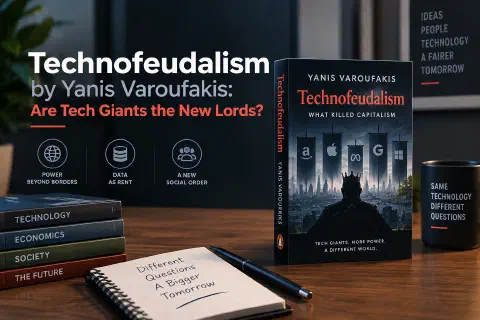
Technofeudalism is a 2023 book by economist Yanis Varoufakis that argues capitalism is being replaced by something closer to feudalism, with a few tech giants acting as lords who control the digital world the rest of us depend on. I read it a few months ago, and it changed how I look at the apps, platforms, and cloud services I use every day.
As someone who works with technology and data, I found the idea both provocative and uncomfortably easy to recognize. Whether or not you agree with the whole argument, it raises a question that matters: are AI billionaires the new digital lords?
What Is Technofeudalism About?
Yanis Varoufakis is a Greek economist who served as his country’s finance minister in 2015. In Technofeudalism, he claims that we are no longer living in classic capitalism, even though the word still gets used for everything. Capitalism, he says, was driven by profit earned by competing in markets. What has taken over, in his view, is a system driven by rent collected by those who own the platforms where markets now happen.
The title is a provocation, but the point behind it is simple. Think of a medieval lord who owned the land: peasants worked it, and the lord took a cut without doing much of the work. Varoufakis argues that the digital version of that land is the platform.
The Key Ideas
Cloud Capital
Varoufakis uses the term cloud capital for the algorithmic platforms and cloud infrastructure that big tech companies own. Unlike a factory, this kind of capital doesn’t only make goods. It also decides what you see, what you can buy, and who can sell to you. If you want the technical side of how this infrastructure works, my guide to cloud computing explains the services underneath.
Cloud Rent
In a normal market, sellers compete with each other. On a platform, the owner sits in the middle and charges a fee for access, such as a commission on sales, a cut of app store revenue, or a payment for advertising reach. Varoufakis calls this cloud rent. The owner doesn’t need to out-compete anyone, because the owner runs the marketplace.
Cloudalists, Vassals, and Cloud Serfs
He gives the new roles names:
- Cloudalists are the owners of the platforms, the digital lords.
- Vassal capitalists are businesses that depend on a platform to reach customers and must pay its fees and follow its rules.
- Cloud serfs are the rest of us, who generate value for free by posting, clicking, reviewing, and sharing data, and often work for platforms without realizing it.
Even if you don’t like the labels, the pattern is familiar. A small business that depends on one marketplace or one search engine for most of its customers has very little power if the rules change.
Are AI Billionaires the New Digital Lords?
This is where the book becomes timely. Training large AI models takes enormous amounts of data, computing power, and money, which only a handful of companies can afford. Those same companies also control the clouds, the chips, and the platforms where AI tools get delivered.
That means a few things worth thinking about:
- Our data feeds the models. Much of the text, code, and images used to train AI came from the work of ordinary people, which is close to Varoufakis’s idea of cloud serfs.
- Access depends on a few providers. If your business builds on one company’s AI service, you’re a vassal in his terms, subject to its pricing and rules.
- Privacy is part of the bargain. What happens to your information matters more as these systems grow. See what data privacy means and how to protect your personal information.
I don’t think this proves that anyone is acting as a lord in the medieval sense. But the concentration of power in a few companies is real, and it’s worth asking who benefits when everything we do runs through their platforms.
My Perspective
I read Technofeudalism as an atheist, a humanist, and a Marxist, so the questions it raises about who owns what are close to my own interests. Marx’s core question was who owns the means of production and who depends on them. In the digital world, the means of production increasingly look like data, platforms, and cloud infrastructure, owned by a very small number of companies. Whether that makes this a new system or a late stage of capitalism is a debate I find fascinating, and I’m not sure the label matters as much as the power relationship underneath it.
My own beliefs shape how I think about the answer:
- Knowledge should be a commons. I believe in the free exchange of knowledge and that it should be accessible to everyone. That’s why I support open-source software: it is one of the clearest examples of people building valuable things together without a landlord taking a cut.
- Technology should serve people. As a humanist, I want tools that expand what people can do, not tools that make people dependent and extract value from their every click.
- Critical thinking is a defense. Understanding how platforms and AI work, and questioning who benefits, is part of being a free person in a digital society.
So are AI billionaires the new digital lords? I think the concentration of ownership is real and worth challenging. I also think the response is not despair but building and defending alternatives: open software, open knowledge, and platforms people actually control.
Where I Disagree (Or at Least Hesitate)
Not everyone accepts that this is a new system. Many economists argue that big tech is still capitalism, just with strong network effects and monopoly power, and that the old tools of competition law and regulation can still apply. The feudalism comparison is a metaphor, and like any metaphor it can overstate things: users can leave a platform in a way a serf could not leave the land, even if leaving can be hard in practice.
Also, the same technology gives people more power in many ways. Anyone can publish a website, learn a skill from free tutorials, or build something with open tools without asking permission.
What Can We Do About It?
You don’t need to quit the internet. A few practical steps reduce your dependence on any single company:
- Use open-source software where it makes sense. It’s harder for one company to lock you in. Here’s why open-source software matters.
- Own your own space. A website and a domain you control, with an email list, means you don’t depend on one platform’s algorithm to reach people.
- Avoid single points of dependency. If your business relies on one platform, keep backups and an alternative.
- Pay attention to your data. Know what you share and with whom.
Questions Worth Discussing
- Are big tech platforms more like marketplaces or more like landlords?
- If AI is built on our collective data, who should benefit from it?
- What would a healthier digital economy look like, and who would have to change for it to exist?
Frequently Asked Questions
What is Technofeudalism about?
It is a book by Yanis Varoufakis arguing that capitalism is being replaced by a system where a few tech companies collect rent from the platforms everyone depends on, much like feudal lords collected rent from land.
What is cloud rent?
It is Varoufakis’s term for the fees and cuts that platform owners collect for access to their digital marketplaces, such as commissions, app store fees, and advertising costs.
What is a cloudalist?
A cloudalist is Varoufakis’s name for an owner of cloud capital, such as a major tech platform, who profits from controlling the digital space where others work and trade.
Is technofeudalism a real economic theory?
It is Varoufakis’s argument, and many economists disagree with it, saying that big tech is still capitalism with strong monopoly power. It is a useful lens for thinking about platform power, even if you don’t accept it fully.
Conclusion
Technofeudalism is a provocative book that makes you look at familiar platforms differently. You may not agree that we’ve left capitalism behind, but the question of who controls the digital world, and who profits from it, is not going away as AI grows.
What do you think? Are AI billionaires the new digital lords, or is this just capitalism with better technology? I’d like to hear your thoughts, so feel free to get in touch.
For an older take on ownership and power, see my review of The Communist Manifesto.
More book reviews: The Future of the Professions by the Susskinds: Book Review, Nexus by Yuval Noah Harari: Information Networks and AI, Manufacturing Consent by Herman and Chomsky: Book Review.