
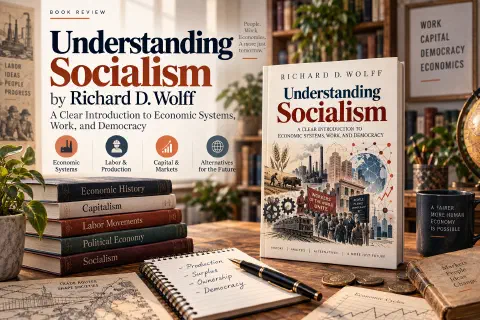
Understanding Socialism (2019) by economist Richard D. Wolff is an accessible introduction to socialism that defines it, in large part, as an economy where workers democratically run their own workplaces. It is a short book aimed at readers with no background in economics.
What Is Understanding Socialism About?
Wolff, a Marxist economist and professor, surveys the history of socialist ideas and movements and compares them with capitalism. He argues that debates about socialism often focus on the role of the state and markets, while he focuses on how the workplace is organized: who makes decisions and who receives the surplus a company produces.
Key Ideas
- Socialism as workplace democracy. In his view, the core idea is that workers collectively run the enterprise, instead of an employer and a board of directors.
- Critique of the employer-employee relationship. He argues that capitalism concentrates decision-making and profits in a small group.
- State ownership is not the same as socialism. He argues that some state-run economies, such as the Soviet Union, functioned like state capitalism because workers still did not control their workplaces.
- Worker cooperatives as a model. He promotes cooperatives as a practical alternative.
Criticisms and Limits
Critics argue that cooperatives remain a small part of most economies and may struggle to raise capital or scale. Others dispute the claim that the Soviet Union and similar states were state capitalism, and some say the book is lighter on the practical problems of planning and incentives. Wolff is also openly an advocate, so readers should compare his case with other views.
My Perspective
As a Marxist, I find Wolff’s focus on the workplace a useful way to talk about socialism without relying on slogans or on the history of any one country. It links to my interest in the question Marx and Engels raised in The Communist Manifesto: who owns the means of production, and who decides? As a humanist, I like the emphasis on democracy and dignity at work. I also think that critical thinking means testing these ideas against evidence and against the strongest objections, instead of just accepting them.
Questions Worth Discussing
- Would you work differently if you helped run your company?
- What stops worker cooperatives from becoming more common?
- Is socialism mostly about ownership, planning, or democracy?
Frequently Asked Questions
What is Understanding Socialism about?
It is an introduction to socialism by Richard D. Wolff that defines it in terms of workers democratically controlling their workplaces.
When was Understanding Socialism published?
In 2019.
Is it a good book for beginners?
Yes. It is short, written for general readers, and does not assume knowledge of economics.
Conclusion
Understanding Socialism is a clear starting point for anyone curious about what socialism means beyond the headlines. Read it, and also read its critics, to form your own view.
What do you think? Could workplace democracy become a realistic alternative to the traditional company? I’d like to hear your thoughts, so feel free to get in touch.
Related Reading
Want to keep reading? These related posts pair well with this one: