
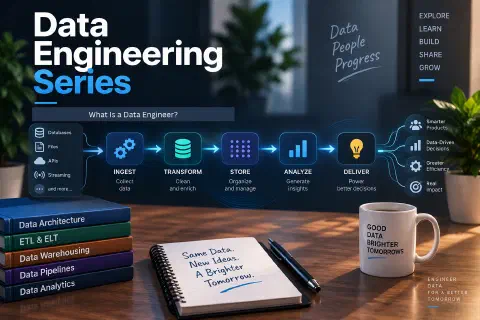
Data Engineering series, Part 1 of 5. This series introduces data engineering from the ground up. Start here, then follow the parts in order:
- What Is a Data Engineer? (you are here)
- What Does a Data Engineer Do?
- Data Engineering Tools: SQL, Python, and Essential Technologies
- What Is a Data Pipeline?
- How to Become a Data Engineer
A data engineer designs, builds, and maintains the systems that collect, move, store, and prepare data, so that analysts, data scientists, and applications can use it. If data is the fuel for modern decisions, data engineers build the pipes, tanks, and refineries that get it to the right place in a usable form.
This guide explains what data engineering is, why it matters, how it differs from related roles, and what a career in the field looks like.
What Is Data Engineering?
Data engineering is the practice of making data reliable and available. Companies collect data from many places: websites, apps, payment systems, sensors, spreadsheets, and third-party services. That raw data is usually messy, scattered, and in different formats. It can’t be analyzed until someone gathers it, cleans it, and stores it in a consistent way.
That someone is the data engineer. The work includes:
- Collecting data from databases, files, APIs, and other sources.
- Moving it into a central location, such as a database or data warehouse.
- Transforming it so it is clean, consistent, and easy to query.
- Keeping it reliable with automation, monitoring, and quality checks.
Why Data Engineering Matters
Analysts and data scientists get the attention for charts and predictions, but their work depends on data being ready. Without good data engineering:
- Data lives in silos. Sales data sits in one system, support tickets in another, and nobody can see the whole picture.
- Numbers don’t match. Two reports show different totals because they use different, unchecked copies of the data.
- Analysts waste their time. Instead of finding insights, they spend most of their day cleaning and combining files by hand.
- Systems break quietly. A failed update means decisions are made on stale or wrong data, and nobody notices.
Data engineering solves these problems once, in a repeatable way, instead of every analyst solving them again each time.
A Simple Analogy: the Water Utility
Think about the water in your home. You turn on a tap and clean water comes out. You don’t think about the reservoirs, pipes, treatment plants, and pumps behind it.
| Water utility | Data engineering |
|---|---|
| Rivers and wells (the sources) | Databases, apps, files, and APIs |
| Pipes that carry the water | Data pipelines |
| Treatment plant that cleans it | Data cleaning and transformation |
| Storage tanks | Databases and data warehouses |
| The tap in your kitchen | Dashboards, reports, and models |
| Workers who keep it running and safe | Data engineers |
The people using the tap (analysts and scientists) care about getting good water. The data engineer cares that the whole system works, every day.
The Data Lifecycle
Data engineers work across the path data takes from where it is created to where it is used:
| Stage | What happens | Example |
|---|---|---|
| Generation | Data is created by systems and people | A customer places an order on your website |
| Ingestion | Data is collected from the source | A nightly job copies new orders from the store’s database |
| Storage | Data is saved in a central place | Orders are stored in a data warehouse |
| Transformation | Data is cleaned, combined, and reshaped | Duplicate orders are removed and totals are calculated |
| Serving | Data is made available to users and tools | A dashboard shows daily sales |
You will see these stages again in What Is a Data Pipeline?.
Data Engineer vs. Data Analyst vs. Data Scientist
These roles work closely together, but they focus on different parts of the process.
| Data Engineer | Data Analyst | Data Scientist | |
|---|---|---|---|
| Main question | “Is the data available and reliable?” | “What happened, and why?” | “What will happen, and what should we do?” |
| Main work | Builds pipelines, databases, and platforms | Analyzes data and builds reports and dashboards | Builds statistical and machine learning models |
| Typical tools | SQL, Python, cloud platforms, orchestration tools | SQL, spreadsheets, BI tools | Python, statistics, machine learning libraries |
| Output | Clean, trusted, accessible data | Insights and visualizations | Predictions and models |
A small company might have one person doing all three jobs. A larger one separates them. To learn about the neighboring roles, read What Is a Data Analyst? and What Is Data Science?.
What Do Data Engineers Work With?
Data engineers handle many kinds of data and systems:
- Relational databases such as PostgreSQL and MySQL. See the PostgreSQL guide.
- Files like CSV, JSON, and columnar formats such as Parquet.
- APIs and web services that provide data on request. Sometimes data has to be collected from websites with web scraping.
- Logs and event streams produced by applications.
- Business applications such as CRMs, payment tools, and marketing platforms.
- Data warehouses and data lakes in the cloud, where data is stored for analysis. See cloud computing explained.
Where Do Data Engineers Work?
Almost any organization that collects data can benefit from one: online stores, banks, hospitals, schools, software companies, logistics firms, media companies, and government agencies. Because the work often involves personal and business data, data engineers also care about data privacy and database security.
Career Opportunities
Job titles vary between companies. You may see:
- Data Engineer: the general title for the role.
- Analytics Engineer: focuses on modeling and transforming data for analysis, often with SQL and similar tools.
- ETL Developer: focuses on building the processes that extract, transform, and load data. See ETL vs ELT.
- Big Data Engineer: works with very large datasets and distributed systems.
- Cloud Data Engineer or Data Platform Engineer: builds data systems on cloud platforms.
Many organizations rely on data, so the field has steady demand, and it pays well compared with many entry-level technical roles. Pay and openings vary a lot by location and experience, so check current job listings and salary surveys rather than relying on any single number. A data engineer role is also a strong stepping stone toward senior engineering, architecture, or management roles.
The Skills at a Glance
You will learn the details later in the series, but the core skills are:
- SQL to query and shape data.
- Python to automate, clean, and move data.
- Databases and data modeling to design how data is stored. See database design.
- Cloud platforms where modern data systems usually run.
- Automation and scheduling so processes run reliably without human help.
- Git, Linux, and Docker for everyday engineering work.
- Communication, because you work with analysts, developers, and business teams.
Part 3 covers the tools in detail, and Part 5 gives a learning roadmap.
Is Data Engineering Right for You?
You may enjoy data engineering if you:
- Like solving problems and building systems that run on their own.
- Are comfortable with programming and databases, or want to be.
- Care about getting details right, because a small mistake can spread into many reports.
- Prefer working behind the scenes over presenting charts.
You may prefer data analysis if you enjoy exploring data and explaining results, or data science if you are drawn to statistics and modeling. Many people start in one role and move into another.
Frequently Asked Questions
What does a data engineer do in simple terms?
A data engineer builds and maintains the systems that gather data from many sources, clean it, and store it, so other people can use it for reports, dashboards, and models.
Is data engineering the same as data science?
No. Data engineers make data available and reliable. Data scientists use that data to build models and make predictions. The roles overlap in some tools, such as Python and SQL.
Do data engineers need to know programming?
Yes. SQL and Python are the most common languages. You don’t need to be a software expert on day one, but you do need to write code.
Is data engineering a good career?
For people who like building systems, it can be an excellent career, with demand across many industries. Look at current job listings in your area to see what is available.
Do I need a degree to become a data engineer?
Many data engineers have degrees in computer science, information systems, or related fields, but employers often value skills and projects. See Part 5 for the full roadmap.
Is data engineering hard to learn?
It takes time because it combines several skills, but you can learn them step by step, starting with SQL and Python. The next articles in this series break it down.
Conclusion
A data engineer builds the foundation that every data-driven decision depends on: systems that collect, clean, and deliver data reliably. The role is different from analysis and data science, but it works closely with both.
If this sounds interesting, continue with Part 2, What Does a Data Engineer Do?, to see the daily tasks and responsibilities in detail.
Next in the Data Engineering series: What Does a Data Engineer Do?