
Tag: SQL
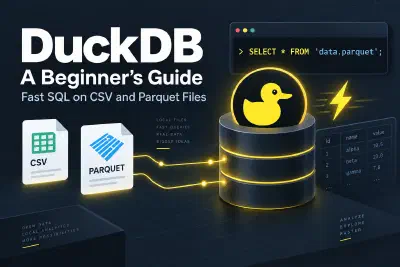
DuckDB: A Beginner's Guide to Fast SQL on CSV and Parquet Files
Learn what DuckDB is and how to query CSV, Parquet, and pandas data with SQL in Python, with a hands-on example project and tips on when to use it.
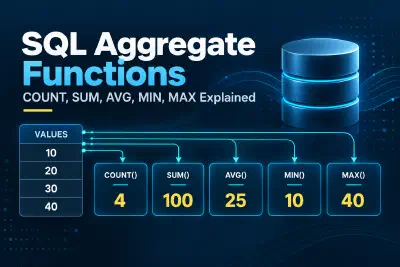
SQL Aggregate Functions: COUNT, SUM, AVG, MIN, MAX Explained
Learn SQL aggregate functions with examples: COUNT, SUM, AVG, MIN, MAX, GROUP BY, HAVING, and NULL handling in PostgreSQL, MySQL, SQL Server, and SQLite.
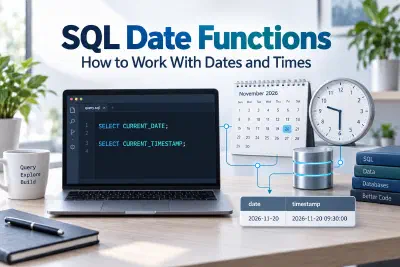
SQL Date Functions: How to Work With Dates and Times
Learn SQL date and time functions with examples: current date, extract, add, subtract, group by month, in PostgreSQL, MySQL, SQL Server, and SQLite.
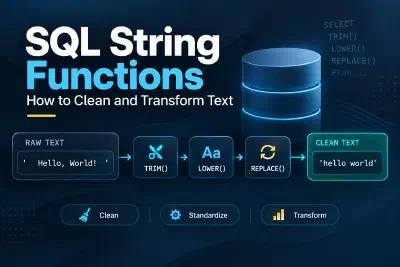
SQL String Functions: How to Clean and Transform Text
Learn the most common SQL string functions with examples: TRIM, UPPER, CONCAT, SUBSTRING, REPLACE, and more in PostgreSQL, MySQL, SQL Server, and SQLite.
What Is SQLite? A Beginner's Guide with Python Examples
Learn what SQLite is, when to use it instead of PostgreSQL or MySQL, and how to create tables, query data, use it from Python, and back it up.
PostgreSQL Backup and Restore: Protecting Your Database
Back up and restore PostgreSQL with pg_dump, pg_restore, and pg_dumpall: backup formats, Docker, automated scripts, physical backups, and restore testing.
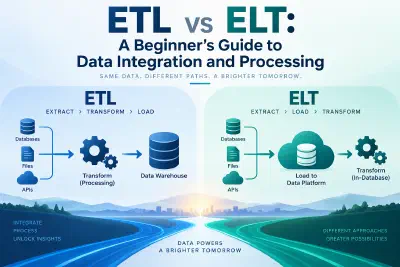
ETL vs ELT: A Beginner's Guide to Data Integration and Processing
ETL vs ELT explained: how they differ and when to use each, with runnable Python and SQL examples, plus tools, pitfalls, and best practices.
SQL and Data Science Interview Questions: Practice Guide
Practice SQL and data science interviews with six real-world questions on one downloadable dataset, with step-by-step answers and common traps.
PostgreSQL for Beginners: A Step-by-Step Guide to Database Management
Learn PostgreSQL step by step: install it, connect with psql, create a database and tables, manage users and permissions, and back up and restore your data.
SQLAlchemy: A Complete Guide to Python Database Management
Learn SQLAlchemy 2.0: connect, define models, run CRUD, use relationships and joins, avoid N+1 queries, manage transactions, and migrate with Alembic.
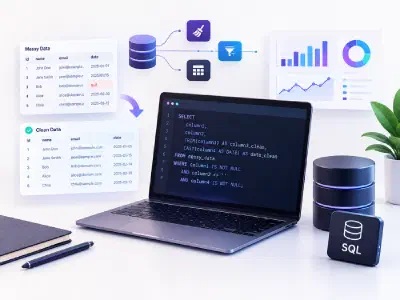
Cleaning Messy Data with Pure SQL: A Beginner's Guide
Learn how to clean messy data with pure SQL, from trimming whitespace to fixing duplicates, with no extra tools needed.
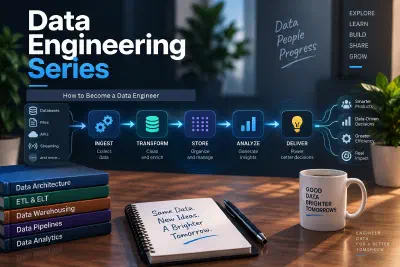
How to Become a Data Engineer: Skills, Certifications, and Career Path
A step-by-step roadmap to becoming a data engineer: skills to learn, education, certifications, portfolio projects, interview prep, and the career path ahead.
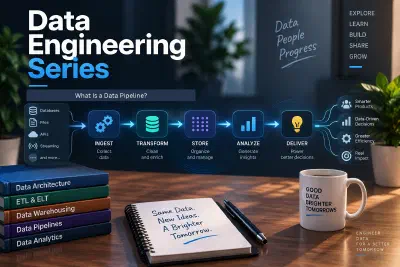
What Is a Data Pipeline? Understanding ETL, ELT, and Data Integration
Learn what a data pipeline is, its stages, batch vs streaming, how ETL, ELT, and data integration fit in, and build a tested mini pipeline in Python and SQL.
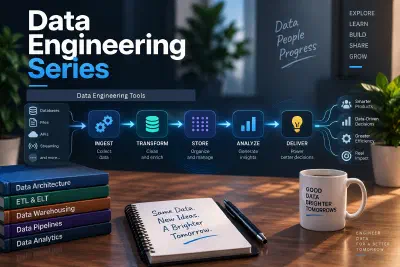
Data Engineering Tools: SQL, Python, and Essential Technologies
A beginner's tour of data engineering tools: SQL, Python, databases, data warehouses, orchestration, cloud platforms, Git, Docker, and what to learn first.

What Does a Data Engineer Do? Roles, Responsibilities, and Skills
See what a data engineer does day to day: building data pipelines, designing databases, ensuring data quality, automating jobs, and the skills the role needs.
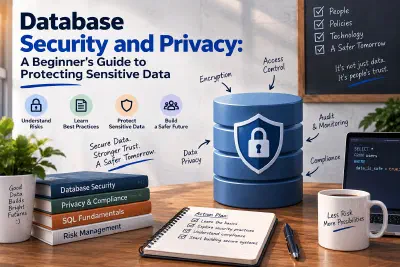
Database Security and Privacy: Protecting Sensitive Data
Learn how to secure a database: access control, encryption (and what data to encrypt), SQL injection defense, backups, auditing, and a practical checklist.
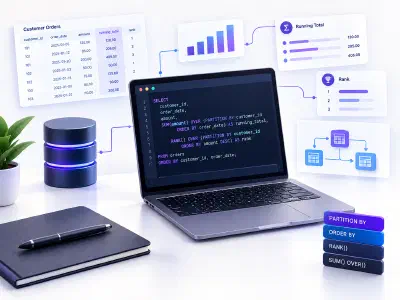
SQL Window Functions: Running Totals & Rankings
Learn SQL window functions for running totals, rankings, and moving averages, with clear beginner examples.

Mastering SQL Subqueries: A Beginner-to-Advanced Guide
A guide to SQL subqueries: syntax, types, and real examples for cleaner, faster queries.
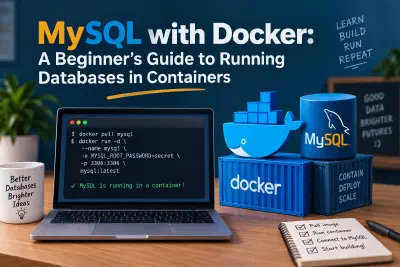
MySQL with Docker: A Beginner's Guide to Running Databases
Run MySQL in Docker: pull the official image, persist data with volumes, set environment variables, and connect from a client or app, step by step.
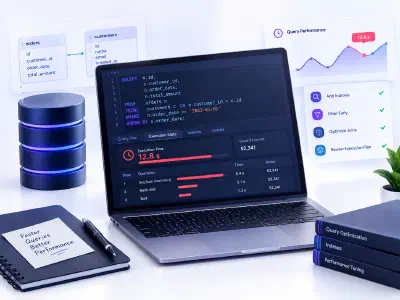
Why Your SQL Query Is Slow (And How to Fix It)
Wondering why your SQL query is slow? Learn the most common causes — missing indexes, SELECT *, bad WHERE clauses — and how to fix them.
Database Design: A Beginner's Guide to Planning It Right
Learn database design step by step — requirements, entities, relationships, and normalization — built for beginner web designers.
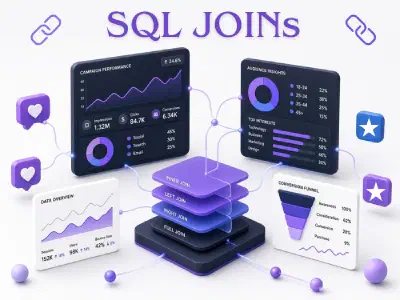
SQL JOINs Explained: A Beginner's Guide
Learn SQL JOINs with clear examples: INNER, LEFT, RIGHT, and FULL JOIN explained for absolute beginners.
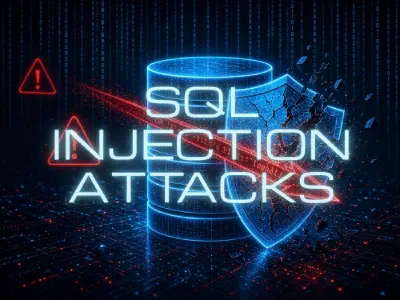
SQL Injection: How It Works and How to Prevent It
Learn what SQL injection is, how attackers exploit it, and how to prevent it with parameterized queries and input validation.
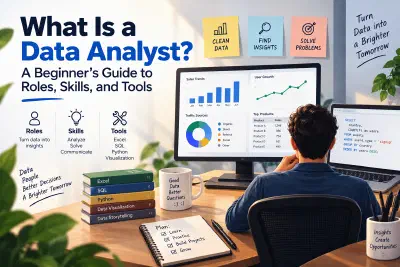
What Is a Data Analyst? A Beginner's Guide to Roles, Skills, and Tools
What a data analyst does, how the role compares to data scientists and engineers, the skills and tools you need, and a step-by-step path to the job.
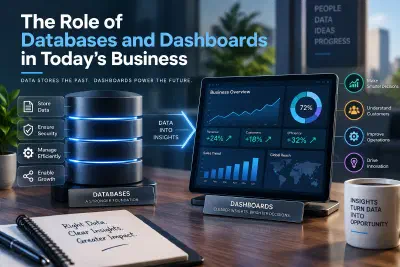
The Role of Databases and Dashboards in Today's Business
Discover the role of databases and dashboards in modern business, from raw data storage to visual, decision-ready reporting.
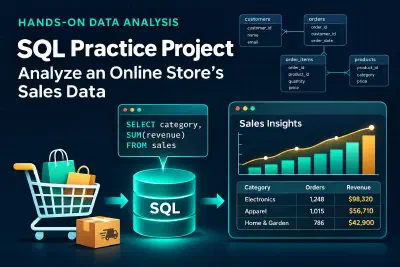
SQL Practice Project: Analyze an Online Store's Sales Data
A guided SQL project: explore a store database, check data quality, calculate revenue KPIs, find top products and customers, and turn queries into findings.
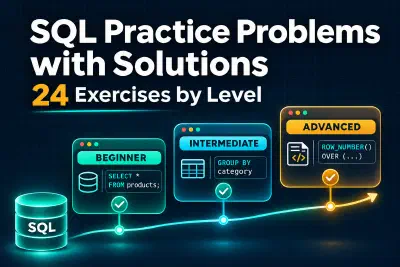
SQL Practice Problems with Solutions: 24 Exercises by Level
24 SQL practice problems with solutions, from beginner to advanced: filters, joins, GROUP BY, CASE, subqueries, CTEs, and window functions on one database.
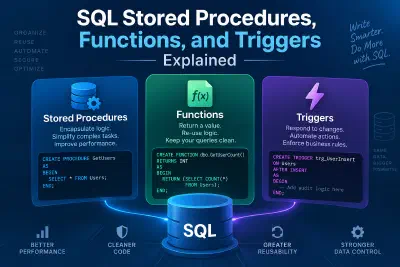
SQL Stored Procedures, Functions, and Triggers Explained
Learn SQL stored procedures, user-defined functions, and triggers with examples in PostgreSQL, MySQL, and SQL Server, plus when to keep logic in the database.
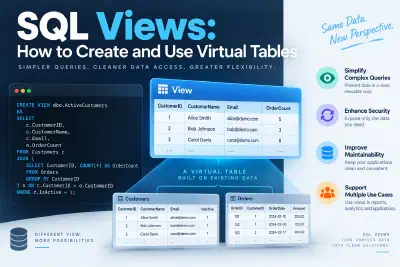
SQL Views: How to Create and Use Virtual Tables
Learn SQL views: save complex queries as virtual tables, simplify reports, restrict access to columns, update data through views, and use materialized views.
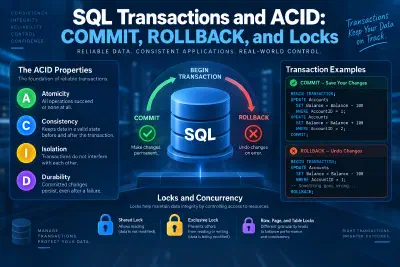
SQL Transactions and ACID: COMMIT, ROLLBACK, and Locks
Learn how SQL transactions keep data consistent: ACID, COMMIT and ROLLBACK, savepoints, error handling, isolation levels, and locks.
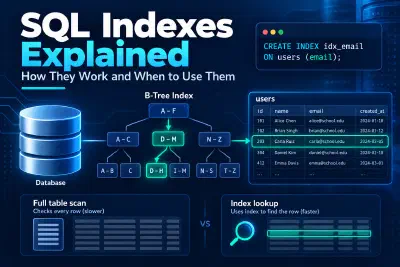
SQL Indexes Explained: How They Work and When to Use Them
Learn how SQL indexes work, how to read EXPLAIN plans, composite and covering indexes, when an index won't help, and the costs of adding too many.
SQL Window Functions Part 2: LAG, LEAD, NTILE, and More
Learn LAG and LEAD for month-over-month changes, FIRST_VALUE and LAST_VALUE, NTILE groups, PERCENT_RANK, percent of total, and the WINDOW clause, with examples.
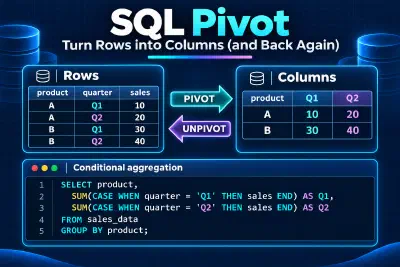
SQL Pivot: Turn Rows into Columns (and Back Again)
Learn to pivot data in SQL: turn rows into columns with CASE and GROUP BY in any database, use PIVOT and crosstab, add totals, and unpivot columns back.

SQL UNION, INTERSECT, and EXCEPT: Combining Query Results
Learn SQL set operations: stack results with UNION and UNION ALL, find rows two queries share with INTERSECT, and rows only one has with EXCEPT, with examples.

SQL CTEs Explained: Cleaner Queries with WITH (and Recursion)
Learn SQL common table expressions (CTEs): write readable step-by-step queries with WITH, chain several CTEs, and use recursive CTEs for date series and trees.

SQL CASE Expressions: If-Then Logic in Your Queries
Learn SQL CASE expressions with examples: label and group values, custom sort orders, conditional counts, CASE in UPDATE, and the mistakes that break them.
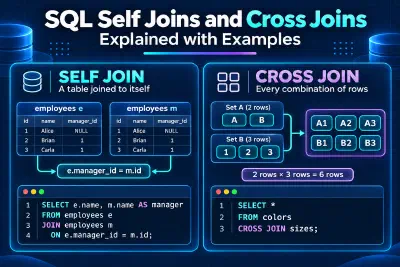
SQL Self Joins and Cross Joins Explained with Examples
Learn SQL self joins and cross joins: compare rows in the same table, show employees with their managers, and build every combination for complete reports.
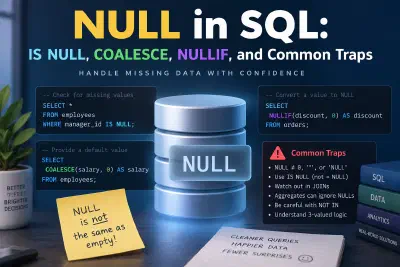
NULL in SQL: IS NULL, COALESCE, NULLIF, and Common Traps
Understand NULL in SQL: why = NULL fails, three-valued logic, IS NULL, COALESCE, NULLIF, NULLs in joins and aggregates, and the NOT IN trap, with examples.

Creating Tables in SQL: Data Types and Constraints
Learn to create tables in SQL: choose data types, add primary keys, foreign keys, UNIQUE, CHECK, NOT NULL, and DEFAULT, and change tables with ALTER TABLE.
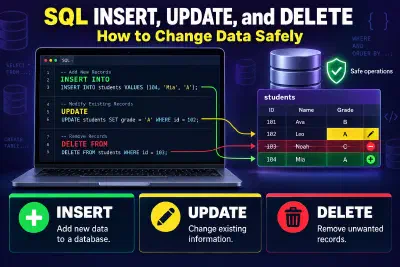
SQL INSERT, UPDATE, and DELETE: How to Change Data Safely
Learn to add, change, and remove data with SQL INSERT, UPDATE, and DELETE, plus upserts, transactions, and the safety habits that prevent costly mistakes.

SQL SELECT Basics: WHERE, ORDER BY, LIMIT, and DISTINCT
Learn to filter, sort, and limit SQL query results with WHERE, AND, OR, IN, BETWEEN, LIKE, IS NULL, ORDER BY, LIMIT, and DISTINCT, with examples you can run.
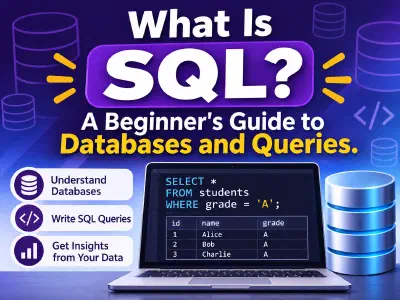
What Is SQL? A Beginner's Guide to Databases and Queries
Learn what SQL is, how relational databases organize data in tables, the main SQL commands, and how to run your first queries on a free sample database.